

Message from Hideo Irimajiri
Five Decades in Pursuit of Spatial Audio
I am Hideo Irimajiri, founder and director of Irimajiri Immersive Audio Laboratory.
Since my undergraduate research days, I have spent more than half a century exploring the possibilities of spatial audio.
"How can I truly realistic sound be created?"
Since the emergence of commercial 3D audio formats, I have also continued to grapple with three further questions:
"How can the appeal of immersive audio be experienced?"
"How can that experience be realized through recording?"
"What is the essence of immersive audio?"
These questions have guided my work for many years.
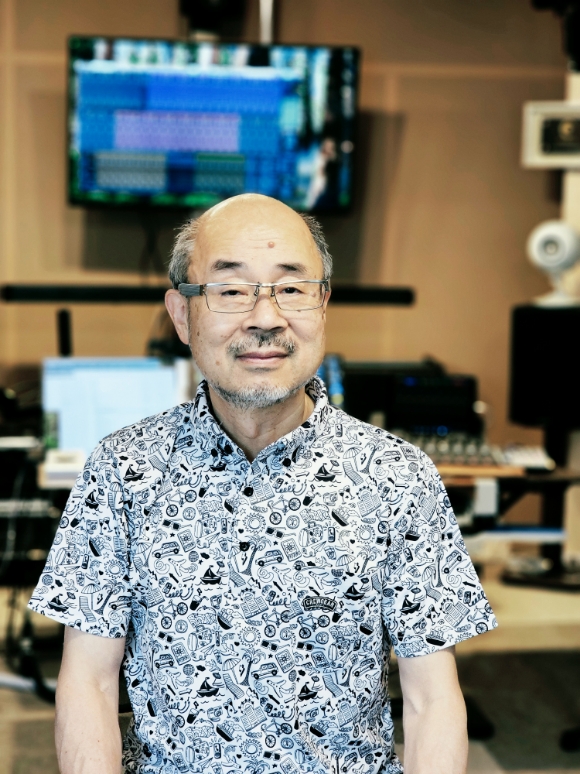
I worked in technical positions at Mainichi Broadcasting System, Inc. and later at WOWOW Inc. Since 2012, I have also been involved in the development of immersive audio technologies, production technologies, and new business initiatives within the broadcasting industry.
In recent years, immersive audio has finally gained broader recognition and is entering a period of wider adoption. Seeing this transition unfold, I felt that this was not the time for me to retire. I therefore decided to establish Irimajiri Immersive Audio Laboratory.
The Recording Professional — Craftsmanship and Science
A recording professional is a craftsman, but it is equally important to have a scientific perspective.
Many recording techniques are grounded in the principles of acoustics and physics. A craftsman's skills are developed through experience and practical knowledge passed down from those who came before. However, particularly in immersive audio recording, there are challenges that cannot be addressed through experience alone.
Attempting to overcome such challenges through trial and error can require an enormous amount of time. A sound understanding of acoustics, however, can provide a more direct path to finding effective solutions.
I hope to share the knowledge and insights I have gained over the years with those who wish to explore audio from a scientific perspective.
Technology Alone Does Not Create Sound
Recording, however, cannot be accomplished through science alone. Exceptional recordings also require sensitivity, intuition, and musical insight.
Recording draws on more than science. Exceptional recordings also require sensitivity, intuition, and musical insight.
This is particularly true in immersive audio, where the ability to evaluate multiple approaches and determine the most appropriate one is essential. Decisions such as microphone placement require experience and critical listening. Developing these abilities requires hands-on practice and the experience gained through actually recording.
The Immersive Audio I Seek
My goal is to create a natural and musical sense of space through immersive audio.
Since my teenage years, I have been deeply involved in music through oboe performance, conducting, and composition. These experiences have cultivated not only my technical skills in recording, but also my ability to perceive sound from a musical perspective.
I am a recording professional as well as a spatial audio creator.
By drawing on both a scientific understanding of acoustics and musical sensitivity, I continue to pursue immersive audio that conveys a genuine sense of presence.
Over the years, I have accumulated knowledge and experience through my work in both music and acoustics. It takes time to build expertise in both, but there is a world of sound that can only be approached by bringing the two together.
I hope to continue contributing to the advancement and wider adoption of immersive audio by drawing fully on the knowledge and experience I have accumulated over the years.
1Profile
Hideo Irimajiri, Ph.D.
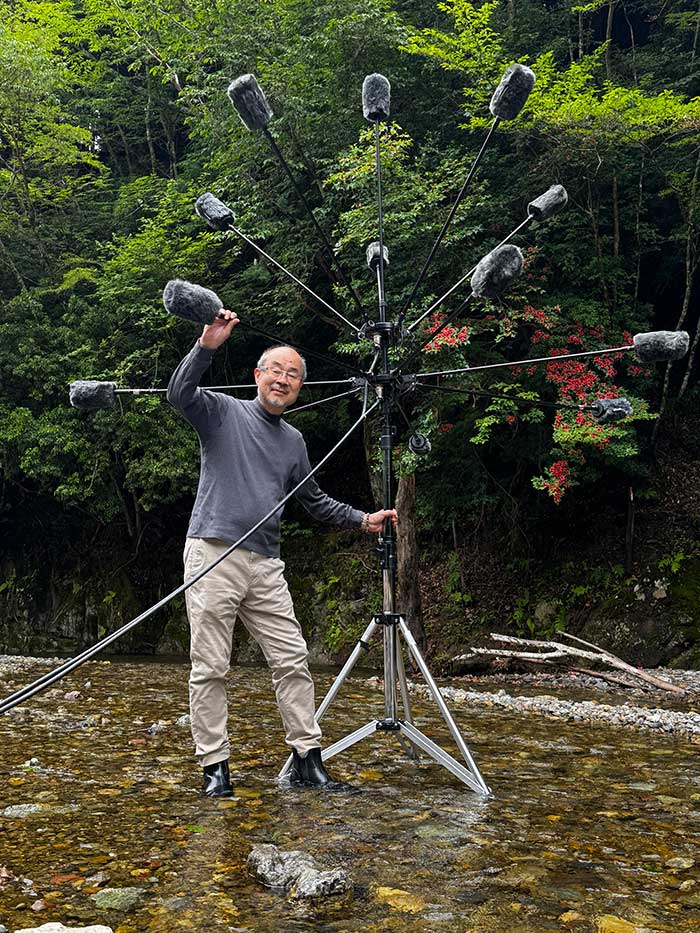
Education
- 1956 Born in Japan
- 1979 Graduated from the Department of Acoustic Design, Kyushu Institute of Design
- 1981 Completed the master’s program at the same institution
- 2013 Earned a Doctor of Design degree from Kyushu University through its doctoral program for working professionals, based on research on reverberation
Professional Experience
- 1981 Joined Mainichi Broadcasting System, Inc. (MBS) in Osaka
- 2013 Joined the New Business Development Study Team at MBS, conducting research and feasibility studies toward the commercialization of immersive audio
- 2017 Transferred to WOWOW Inc. in Tokyo, where he was responsible for the development of immersive audio production technology and business initiatives
- 2025 Retired from WOWOW; founded Irimajiri Immersive Audio Laboratory in June of the same year
Qualification
- First-Class Special Radio Operator for On-the-Ground Service (Japan)
Licensed on October 25, 1984
2Professional Journey
Throughout his career, Hideo Irimajiri has been involved in research, development, production, and outreach across the fields of broadcast audio, surround recording, reverberation research, loudness technology, and immersive audio production technology. As a recording engineer, he has also contributed to the production of a wide range of content, including music, performing arts, and live sports broadcasts.
The following highlights some of his major professional achievments.
Research & Technology Development
1. Surround Recording and Spatial Acoustics Research
In 2006, Hideo Irimajiri led the AES Japan Section’s Surround Recording Experiment. He conducted research evaluating various microphone array techniques for orchestral recording, contributing to the development of surround recording technology in Japan.
Selected Research Presentations
- “Characteristics of Various Microphone Arrays for Orchestral Recording”
Report on the AES Japan Section Surround Recording Experiment
AES Japan Conference, Osaka (2007) - “Hands-on Demonstration: Subjective Evaluation by Reference Recordings with Surround Main Mikings for Classical Orchestra”
Workshop
122nd AES Convention, Vienna (2007) - “Evaluation of Surround Main Mikings for Classical Orchestra”
Workshop
123rd AES Convention, New York (2007) - “AES Surround Recording Experiment: Orchestral Recording at The Symphony Hall”
Broadcast Technology, Vol. 61, May issue, pp. 136–145 (2008)
2. Reverberation Research and Acoustic Evaluation
As part of the doctoral program for working professionals at the Graduate School of Design, Kyushu University, Hideo Irimajiri conducted research on the application of artificial reverberation to anechoic recordings. His research clarified the relationship between the characteristics of musical performances and their optimum reverberation levels.
These research findings later became a foundation for his work in immersive audio production technology and culminated in his earning a Doctor of Design degree in 2013.
Selected Research Presentations
- “Investigation of the Optimum Level of Artificial Reverberation Added to Anechoic Recordings by Mixing Engineers” (2008)
Technical Report MA2008-70, Technical Committee on Musical Acoustics, Acoustical Society of Japan, pp. 29–34 - “Investigation of the Optimum Level of Artificial Reverberation for Anechoic Recordings” (2009)
Joint Technical Report AA2009-66 / MA2009-74, Technical Committees on Architectural Acoustics and Musical Acoustics, Acoustical Society of Japan - “Optimum Reverberation Level for Anechoic Recordings of Orchestral Performances” (2013)
Co-authored with Shin-ichiro Iwamiya, Journal of the Acoustical Society of Japan, Vol. 69, No. 5, pp. 215–223
Doctoral Dissertation
- “Optimum Reverberation Levels for Musical Performances
— A Study of the Relationship Between Audio Signal Characteristics and Optimum Mixing Levels of Artificial Reverberation Using Anechoic Recordings —” (2013)
Doctoral Dissertation, Graduate School of Design, Kyushu University
3. Loudness Research and Broadcast Audio Technology
Hideo Irimajiri conducted research and development in loudness management for the digital broadcasting era. As a member of committees at both ARIB and the Japan Commercial Broadcasters Association (JBA), he was involved in developing and promoting loudness guidelines for broadcasting. Through his work on broadcast audio evaluation methods, loudness measurement technologies, and operational support tools, he helped establish loudness management practices throughout the Japanese broadcasting industry.
Selected Publications and Technical Reports
- “How Should Transmission Audio Levels Be Managed in Digital Broadcasting?” Broadcast Technology, Vol. 61, No. 7, pp. 160–167 (2008)
- “Development of an Analog Loudness Meter” Broadcast Technology, Vol. 63, No. 12, pp. 159–168 (2010)
- “Loudness Measurement Algorithms and Their Characteristics” Broadcast Technology, Vol. 65, No. 9, pp. 63–68 (2012)
- “Verification of Loudness Management — Part 1” Broadcast Technology, Vol. 67, No. 3, pp. 129–136 (2014)
- “Verification of Loudness Management — Part 2” Broadcast Technology, Vol. 67, No. 5, pp. 171–176 (2014)
- “Development of a Universal Loudness Controller” Broadcast Technology, Vol. 68, No. 8, pp. 90–98 (2015)
Selected Lectures and Conference Presentations
- Inter BEE Audio Symposium (2010)
“Will Loudness Standards Free Viewers from Constant Volume Adjustment?” - Inter BEE Seminar Series (2011)
“Loudness Summit”
Planned and chaired a three-day seminar series explaining Japan’s loudness operational guidelines from both theoretical and practical perspectives, immediately prior to the introduction of loudness-based broadcasting. - Inter BEE Audio Symposium (2013)
“Has Loudness Management Been Successful?”
Selected Serial Publications
- PROSOUND Magazine (2009–2013)
“PROSOUND Seminar: Loudness Control in the Digital Era” (six-part series)
This six-part series explained loudness measurement technologies, operational standards, and practical challenges in broadcasting, combining theoretical principles with real-world examples.
4. Immersive Audio Production Technology
Beginning in 2013, while at Mainichi Broadcasting System, Hideo Irimajiri was involved in new business development for immersive audio and initiated a proof-of-concept project for Dolby Atmos. After joining WOWOW Inc. in 2017, he promoted the development of production technologies based on the concept of high-resolution 3D audio, as well as research into distribution technologies, content production, and outreach activities to promote immersive audio.
Selected Technical Reports and Production Case Studies
- “Immersive 3D Audio Recording: Makoto Nagura — Bach Parallels” PROSOUND Magazine, Vol. 219, October 2020
- “Demonstration of Enhanced Audio for Video Streaming Using MQA and AURO-3D Audio” PROSOUND Magazine, Vol. 221, February 2021
- “Production Notes: Isao Tomita’s The Tale of Genji — Symphonic Fantasy Scroll (2014 Revised Edition)” PROSOUND Magazine, Vol. 223, June 2021
- “High-Resolution 3D Audio Streaming and Development of the Ω (Omega) Player” PROSOUND Magazine, Vol. 225, December 2021
- “Production Notes: Bob James — Feel Like Making LIVE! in 3D Immersive Audio” PROSOUND Magazine, Vol. 226, February 2022
- “An Approach to Live Streaming in High-Resolution 3D Audio” PROSOUND Magazine, Vol. 227, April 2022
Selected Magazine Series
- PROSOUND Magazine (2021–2023)
“A Practical Guide to Immersive Audio Production” (nine-part series)
This nine-part series provided a systematic overview of the theory and practice of immersive audio production, covering loudspeaker configuration, recording techniques, immersive audio formats, acoustics, mixing, sound-field capture, and sound quality evaluation.
5. Specialized Book
Contributing Author
- The Acoustical Society of Japan (ed.), Sound and Time (Acoustical Science Series 13), Corona Publishing Co., Ltd. (2015)
Contributed chapter: Chapter 8, “Acoustics and Time in Broadcasting Technology”
6. Other Activities
Under the pen name Jiro Irimaji, Hideo Irimajiri has also been involved in music production. His work includes the theme song “Cosmic Rugby” for the National High School Rugby Tournament, the television title theme “Victory” for the Dunlop Phoenix Tournament, and music production for the PC game Record of Lodoss War.
3Publications — Chronological Order

- 1.Sound Quality Evaluation of Audio Compressed with MPEG-2 AAC
- 2.Sound Quality Evaluation of Audio Compressed with MPEG-2 AAC
- 3.Workshop “Hands-on Demonstration: Subjective Evaluation by Reference Recordings with Surround Main Mikings for Classical Orchestra”
- 4.Report on the AES Japan Section Surround Recording Experiment: Characteristics of Various Microphone Arrays in Orchestral Recording
- 5.Workshop “Evaluation of Surround Main Mikings for Classical Orchestra”
- 6.Report on the AES Surround Recording Experiment
- 7.AES Surround Experiment: Orchestral Recording at The Symphony Hall
- 8.What Should Transmission Levels Be in Digital Broadcasting?
- 9.5.1 Surround Terakoya Lab: Surround Production of the SACD Planet Earth
- 10.PROSOUND Seminar: Loudness Control in the Digital Age, Part 1
- 11.A Study of Mixing Engineers’ Preferred Levels for Adding Artificial Reverberation to Anechoic Recordings
- 12.PROSOUND Seminar: Loudness Control in the Digital Age, Part 2
- 13.PROSOUND Seminar: Loudness Control in the Digital Age, Part 3
- 14.On the Relationship Between the Characteristics of Anechoically Recorded Musical Signals and the Optimum Reverberation Mixing Level
- 15.On the Relationship Between the Characteristics of Anechoically Recorded Musical Signals and the Optimum Reverberation Mixing Level
- 16.A Study of the Optimum Level for Adding Artificial Reverberation to Anechoic Recordings
- 17.A Study of Broadcast Audio Processing Intelligible to Both Older and Normal-Hearing Listeners Under Realistic Listening Conditions
- 18.A Comparison of Subjective and Computed Loudness Values for Broadcast Audio
- 19.Can Loudness Standards Free Viewers from the Remote Control Volume Button?
- 20.Development of an Analogue Loudness Meter
- 21.Inter BEE Audio Symposium Report: Loudness Standards for Audio
- 22.Round-table Discussion: Will Loudness Practice Change Television Audio?
- 23.Loudness Summit
- 24.How Do We Bring Programmes to the Loudness Target?
- 25.Will Loudness Practice Change Broadcasting? Will It Spread to Other Media?
- 26.Loudness Measurement Algorithms and Their Characteristics
- 27.PROSOUND Seminar: Loudness Control in the Digital Age 2, Part 1
- 28.PROSOUND Seminar: Loudness Control in the Digital Age 2, Part 2
- 29.The Optimum Reverberation Level for Anechoically Recorded Orchestral Performance
- 30.PROSOUND Seminar: Loudness Control in the Digital Age 2, Part 3
- 31.The Optimum Reverberation Level for Musical Performance: A Study of the Relationship Between Source Signal Features and the Optimum Reverberation Mixing Level, Using Anechoic Recordings and Artificial Reverberation
- 32.PROSOUND Seminar: Loudness Control in the Digital Age 2, Part 4
- 33.(Invited Lecture) Operating Broadcast Audio Using Average Loudness Values
- 34.PROSOUND Seminar: Loudness Control in the Digital Age 2, Part 5
- 35.Has Loudness Practice Succeeded?
- 36.PROSOUND Seminar: Loudness Control in the Digital Age 2, Part 6
- 37.Verifying Loudness Practice, Part 1
- 38.Verifying Loudness Practice, Part 2
- 39.Sound and Time in Broadcast Engineering
- 40.Development of a Universal Loudness Controller
- 41.Immersive 3D Audio Recording: Makoto Nakura, Bach Parallels
- 42.Demonstrating Advanced Audio for Video Streaming: Video Delivery Using MQA and AURO-3D Audio
- 43.An Introduction to Immersive Audio Production, Part 1: Loudspeaker Layout
- 44.Isao Tomita, The Tale of Genji: Symphonic Fantasy (2014 revised version) — Production Notes
- 45.An Introduction to Immersive Audio Production, Part 2: The Various Formats and Their Loudspeaker Layouts
- 46.An Introduction to Immersive Audio Production, Part 3: Acoustics Worth Knowing
- 47.High-Resolution 3D Audio Streaming and the Development of the ω Player
- 48.Bob James, Feel Like Making Live! — 3D Immersive Audio Production Notes
- 49.An Experiment in Live Streaming of High-Resolution 3D Audio
- 50.An Introduction to Immersive Audio Production, Part 4: Understanding the Techniques for Capturing Acoustic Space
- 51.An Introduction to Immersive Audio Production, Part 5: Mixing Channel-Based
- 52.An Introduction to Immersive Audio Production, Part 6: Seeing Sound
- 53.An Introduction to Immersive Audio Production, Part 7: The Essence of 3D Audio Production
- 54.An Introduction to Immersive Audio Production, Part 8: 3D Audio Production and Sound Quality
- 55.An Introduction to Immersive Audio Production, Part 9: Sound Field Capture and Expression
4Discography
(Works as Balance Engineer)

- 1.DVD: Takashi Asahina 90th Birthday Memorial Concert Osaka Philharmonic Orchestra, 320th Subscription Concert
- 2.Osaka Municipal Symphonic Band, 80th Subscription Concert — live CD “Casanova”
- 3.Osaka Municipal Symphonic Band, 81st Subscription Concert — live CD Earth, Water, Sun, Wind
- 4.Osaka Municipal Symphonic Band, 82nd Subscription Concert — live CD Sinfonia Hungarica
- 5.Commemorating the Pregnancy of Crown Princess Masako — Lullaby “Omedeto”: A Message to the Angel
- 6.Osaka Municipal Symphonic Band, 83rd Subscription Concert — live CD Symphonie fantastique
- 7.Osaka Municipal Symphonic Band, 84th Subscription Concert — live CD Spartacus
- 8.Yasushi Miyagawa: The Hit Parade
- 9.Osaka Municipal Symphonic Band, 85th Subscription Concert — live CD Poema Alpestre
- 10.Osaka Municipal Symphonic Band, 86th Subscription Concert — live CD The Inn of the Sixth Happiness
- 11.Wind Music by the Great Composers
- 12.Osaka Municipal Symphonic Band, 87th Subscription Concert — live CD Sinfonietta (Sketches of a City on the Water)
- 13.Osaka Municipal Symphonic Band, 88th Subscription Concert — live CD Odyssey
- 14.Osaka Municipal Symphonic Band, 89th Subscription Concert — live CD Klezmer Classics
- 15.Osaka Municipal Symphonic Band, 90th Subscription Concert — live CD Sparke: Music of the Spheres
- 16.Osaka Municipal Symphonic Band, 91st Subscription Concert — live CD Gilgamesh
- 17.Sadako Yanagi Meu Fado (My Fado)
- 18.Osaka Municipal Symphonic Band, 92nd Subscription Concert — live CD Flashing Winds
- 19.Osaka Municipal Symphonic Band, 93rd Subscription Concert — live CD The Tower of Babel
- 20.Osaka Municipal Symphonic Band, 94th Subscription Concert — SACD Planet Earth
- 21.Osaka Municipal Symphonic Band, 95th Subscription Concert — live CD Suite: The Miraculous Mandarin
- 22.Makoto Nakura / BACH BEAT (SACD)
- 23.Osaka Municipal Symphonic Band, 96th Subscription Concert — live CD Symphony of Fables
- 24.Toshiyuki Chaki / Auf einer Wanderung
- 25.Makoto Nakura / Wood and Forest
- 26.Contraponto’s Vespro
- 27.Makoto Nakura / BACH BEAT II
- 28.Makoto Nakura / Tears and Prayers
- 29.Isao Tomita: The Tale of Genji — Symphonic Fantasy, Orchestra recording version
- 30.Moonlight Desert: String Instruments and Songs Crossing the Silk Road
- 31.Feel Like Making Live!
- 32.The BIG Finish Live
- 33.A Shade of Blue
- 34.Nostalgia of the Future Vol. 1: Japonism
- 35.Nostalgia of the Future Vol. 2: The Orient and Japan
- 36.Nostalgia of the Future Vol. 3: Gems in Miniature
- 37.Nostalgia of the Future Vol. 4: Harmonia I
- 38.Nostalgia of the Future Vol. 5: Harmonia II
- 39.Resonscape I — Resonance in Silence
- 40.Resonscape II — After the Resonance
- 41.Resonance Across the Centuries — Hall of Halls
5Musical Works (Compositions)

- 1.Game music Deep Dungeon Madou Senki
- 2.Game music Deep Dungeon II Yuushi no Monshou (Crest of the Brave)
- 3.Dunlop Phoenix Tournament, programme title theme “Victory”
- 4.High School Rugby, programme title theme “Cosmic Rugby”
- 5.Game music CD Record of Lodoss War ~The Gray Witch~
- 6.Game music CD Record of Lodoss War II ~Goshiki no Maryuu (The Five-Coloured Dragon)~

