
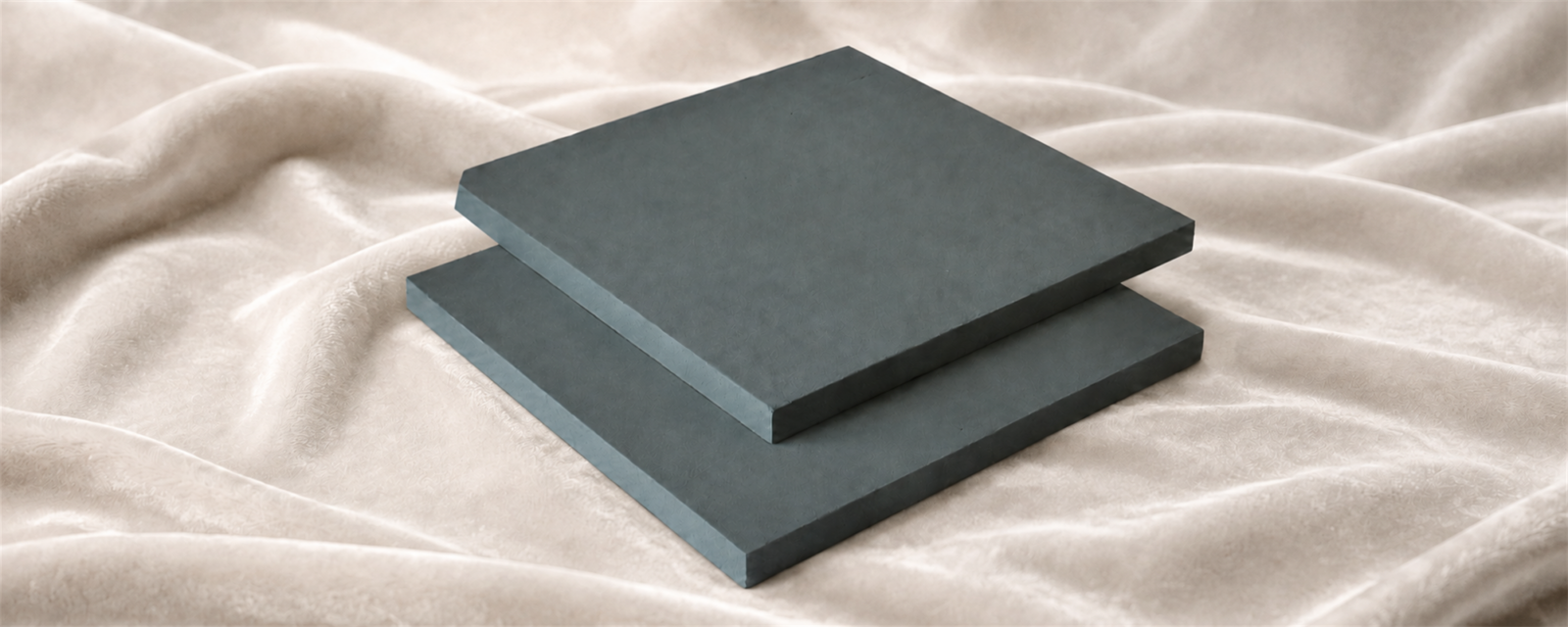
The sound-absorbing material used at this laboratory, CALMOFOAM, is an acoustic foam made by Matsumura Aqua Co., Ltd. It has the properties of both absorbing and blocking sound. Since sound absorption and sound insulation are normally difficult to achieve together, a material that provides both at once can fairly be called groundbreaking.
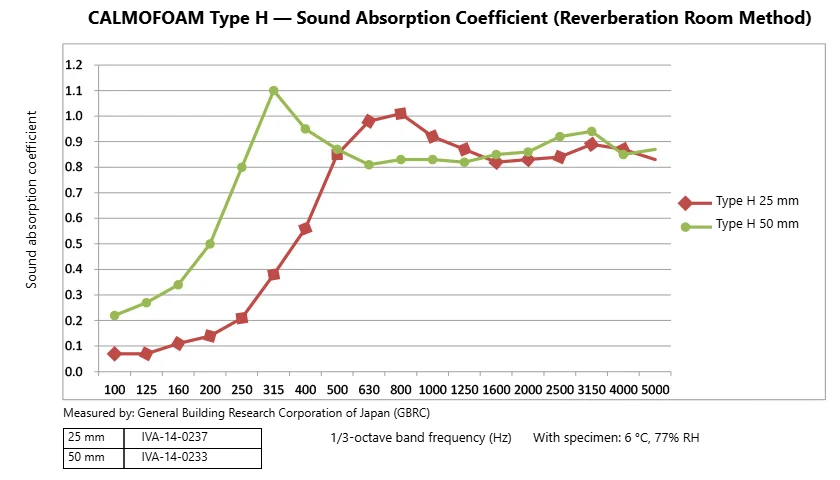
As for absorption, it has the characteristic of not absorbing excessively at high frequencies while absorbing well in the low and middle range. Graph 1 shows the absorption coefficient of CALMOFOAM in thicknesses of 50 mm and 25 mm; the vertical axis is the absorption coefficient and the horizontal axis is frequency. As one would expect, the thicker material absorbs more, and absorbs down to lower frequencies.
With ordinary glass wool, sound waves — vibrations of the air — pass through the gaps between fine fibres, and friction and the viscous resistance of the air turn the vibration into heat, attenuating the sound energy.
CALMOFOAM, by contrast, has a structure through which almost no air passes. It therefore converts sound energy into heat not by friction but
by a mechanism of resonance, though the detailed mechanism is not understood. When I put the question to a specialist in porous materials in environmental acoustics at Kobe University, the answer was that they had never seen a material with these characteristics.
CALMOFOAM: Sound Absorption Coefficient vs. Frequency
This property is also evidence that the material blocks sound. It does not, of course, provide insulation on the scale of concrete. At 50 mm thickness, however, it gives an average of 18 dB, which makes it very well suited to reinforcing sound insulation. It is especially useful in domestic settings such as home theatres, where one wants to strengthen the insulation a little while also improving the way the sound is heard.
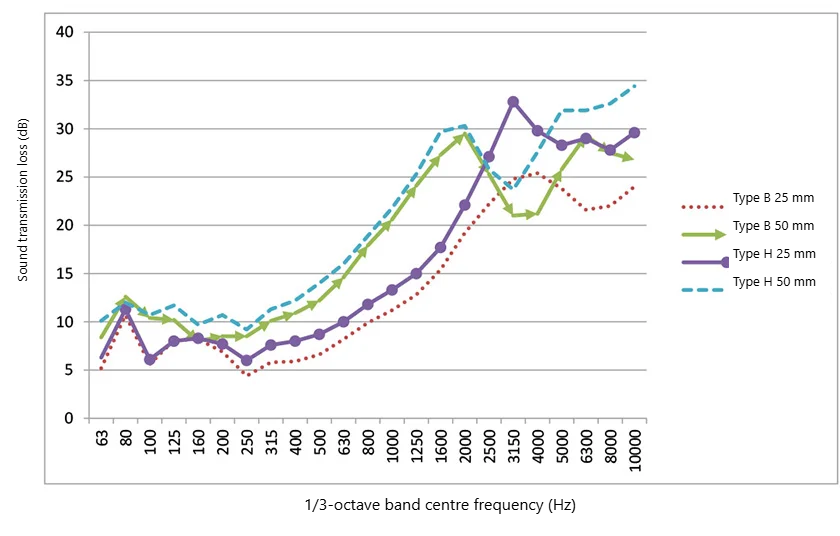
CALMOFOAM: Transmission Loss vs. Frequency
CALMOFOAM’s characteristic of not absorbing too much at high frequencies while absorbing the low and middle range well is very convenient for adjusting the reverberation of a room. A studio or a listening room needs a certain amount of reverberation. If too much is absorbed and the room approaches an anechoic chamber, accurate judgement in music production and in listening becomes difficult.
The one disappointing point about CALMOFOAM is that it is not a non-combustible material. A material without non-combustibility certification is hard to use as a building material in premises where the general public gathers. As this laboratory is a private studio it is debatable whether that requirement applies, but rather than fixing the panels to the building we installed them as partitions, so that they would not be treated as part of the structure.
Glass wool is the usual sound-absorbing material in studios. Because glass wool tends to absorb too much of the high frequencies, however, reflective materials are often deliberately built into key places on the walls. In the low range, on the other hand, glass wool alone is often insufficient, and large low-frequency absorbers known as bass traps are sometimes used alongside it.
Even so, low-frequency resonances known as standing waves often arise and muddy the sound.
At this laboratory we were able to solve this problem with large panels made of CALMOFOAM only 50 mm thick. Naramachi Studio is a rented property, so nothing can be fixed directly to the walls. We therefore built frames with a tension-mounted 2×4 system and installed the panels as partitions.
There are four panel surfaces in all, about 20 square metres in total, and the result is particularly satisfying in the low and middle range. Because the property is rented we could not treat the ceiling, so some reflection from the ceiling remains audible; even so, we feel we have secured performance that stands comparison with a commercial studio. It is no exaggeration to say that the acoustic tuning provided by CALMOFOAM contributes greatly to the resolution of the sound in this studio.
How a Chance Discovery Led to CALMOFOAM
How did I arrive at CALMOFOAM? It goes back to the time when I was in charge of master control operations at Mainichi Broadcasting System. Digital broadcasting was just then getting under way at broadcasters. New dedicated equipment was being brought in one after another, and the digital devices of the day threw out heat like heaters. Cooling fans ran at high speed to carry the heat away, and they were correspondingly loud. The room where several machines stood side by side was filled with noise so unbearable that it was hard even to concentrate on the work.
Then one day, while monitoring a programme, I happened to see a sound-absorbing panel called Shizuka being introduced. If we used this for the lids of the equipment racks, I thought, perhaps we could hold the noise down. We duly fitted lids made of Shizuka panels to the racks of digital equipment in the room. The panels were a mere 20 mm thick, yet measurement confirmed an improvement of 7 to 8 dB.
Normally a double structure combining absorbent material with an insulating panel is needed to obtain a large noise-reduction effect. Here a single thin panel reduced the noise to a clearly perceptible degree.
It was astonishing performance.
I remembered something said in the programme: that the core was made of the same material as the floral foam used in flower arranging. Following that clue, I found that a company dealing in floral materials, Matsumura Kogei, was involved in manufacturing it.
Then something even more surprising happened. That company’s branch office turned out to be in the building directly opposite Mainichi Broadcasting System. What are the chances of that? I visited the branch straight away and asked about the material and its performance. As the conversation went on, it emerged that they too were looking for new applications that would make use of the material.
We were troubled by noise and looking for a solution; the manufacturer had an excellent material and was looking for new ways to use it. The two came together, and in time we carried out a joint evaluation of its performance.
It began with a single sound-absorbing panel that caught my eye during programme monitoring. That chance discovery eventually led to CALMOFOAM, now used at Naramachi Studio.

