
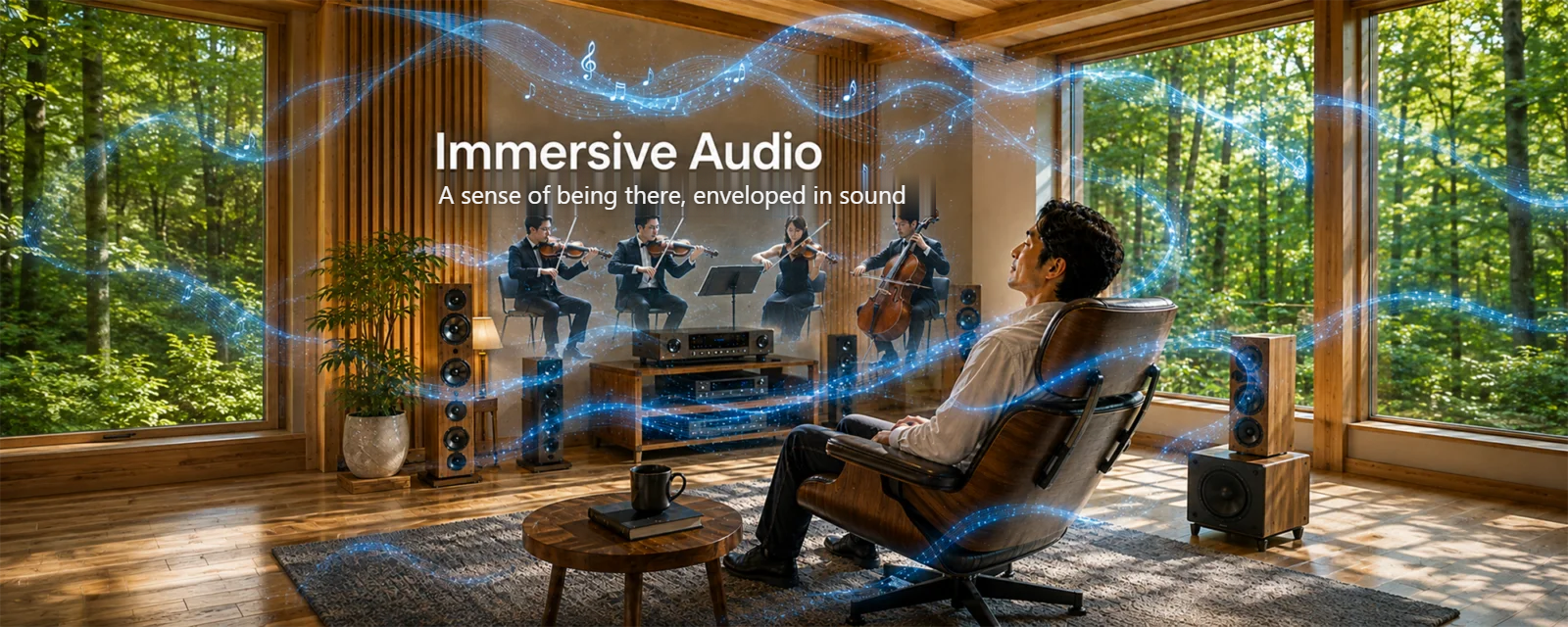
How the Term “Immersive Audio” Was Born
The following is a summary of a message sent directly to this website by Wilfried Van Baelen, the creator of the AURO-3D format, whom I contacted to ask him to explain the origin of the term “Immersive Audio” and its background.
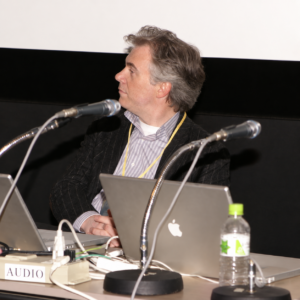
Wilfried Van Baelen, chairman of Auro Technologies (Note 2), the company that introduced the AURO-3D format, explains that he proposed the term “Immersive Audio” at the AES (Audio Engineering Society) (Note 1) International Conference in Tokyo in 2010 as the name for a new category encompassing modern three-dimensional sound.
Wilfried Van Baelen speaking at the AES International Conference in Tokyo, 2010
At the time, a variety of words were being used for the new concept of three-dimensional sound reproduction and the terminology was not settled. As the Tokyo conference approached, Van Baelen felt that this new category of sound needed a single word that was comprehensive and intuitively understandable.
The idea came from a reaction listeners had voiced repeatedly ever since the first demonstrations of AURO-3D: that the sound was “immersive.”
Whereas conventional surround sound surrounds the listener mainly in the horizontal plane, three-dimensional sound adds vertical acoustic information, creating the sensation of being inside a three-dimensional sound field. This makes a more natural, more lifelike listening experience possible.
Van Baelen therefore proposed calling this listening experience
“Immersive Sound”
and the technology and field behind it
“Immersive Audio,”
as an umbrella term for three-dimensional sound that goes beyond horizontal surround to include the height dimension.
He then used the names “Immersive Sound” and “Immersive Audio” consistently as AURO-3D was commercialized.
In 2011, together with Barco, he introduced Auro 11.1 to the digital cinema market. A brochure produced at the time by Barco and Galaxy Studios carried the headline, ”Get Ready for a Truly Immersive Sound Experience” and described AURO-3D as a technology that turns conventional cinema audio into a fully immersive 3D sound experience.
The same brochure positioned AURO-3D as the next-generation 3D sound format for the film industry, explaining that adding a height axis to conventional horizontal surround sound delivers a natural three-dimensional listening experience that envelops the audience.
In 2012 the SMPTE Cinema Sound Systems technology committee (TC-25CSS), chaired by Brian Vessa, was established, and work began on standardizing immersive sound systems for digital cinema.
Van Baelen states that he took part in this standardization work and pressed for “Immersive Sound” and “Immersive Audio” to be adopted as the terms for the new category of three-dimensional sound. Auro Technologies and Barco later joined DTS and others in proposing an open cinema sound standard that would allow different immersive sound systems to interoperate.
Following this standardization work by a number of companies and specialists, SMPTE published the following standards in 2018.
- SMPTE ST 2098-1: Immersive Audio Metadata
- SMPTE ST 2098-2: Immersive Audio Bitstream Specification
- SMPTE ST 2098-5: D-Cinema Immersive Audio Channels and Soundfield Groups
ST 2098-2 was subsequently revised in a 2019 edition.
PCMag summarizes this sequence of events, noting that it was the success of Auro-3D in 2010 and of Dolby Atmos in 2012 that led SMPTE to finalize its immersive audio standards as SMPTE 2098 in 2019.
It is from this history and these achievements that Wilfried Van Baelen has come to be called “the Father of Immersive Audio.”
Van Baelen’s contribution goes beyond proposing the term. He developed AURO-3D into a comprehensive immersive audio solution spanning the principal fields of sound — music, digital cinema, home entertainment, automotive, games and broadcasting.
It covers the whole chain from production to playback: capturing, producing, distributing and reproducing three-dimensional sound.
More recently, “AuroMasters,” which he designed, has also been launched — a platform for streaming AURO-3D music anywhere in lossless, studio-grade quality.
An Earlier Use: The 1998 IEEE Paper
The English expression “Immersive Audio” itself can, on the other hand, be found in academic literature before 2010.
The best-known earlier example is a 1998 IEEE paper by Chris Kyriakakis of the University of Southern California (USC).
Chris Kyriakakis,
“Fundamental and Technological Limitations of Immersive Audio Systems,”
Proceedings of the IEEE, Vol. 86, No. 5, pp. 941–951, May 1998.
DOI: 10.1109/5.664281
The manuscript was received in September 1997, which means that the expression “Immersive Audio Systems” was already in use in technical research by 1997 at the latest.
The paper states that a key challenge in realizing immersive audio is to reproduce a three-dimensional sound field while preserving the intended spatial positions, frequency response and dynamic range, explicitly linking immersive audio with the reproduction of a three-dimensional sound field.
The approaches covered in the paper are not limited to systems with height loudspeakers, such as today’s AURO-3D. They include binaural headphone reproduction using HRTFs, reproduction using multiple loudspeakers, and transaural methods. The paper also discusses Ambisonics and Wave Field Synthesis.
It further describes the purpose of an immersive system as synthesising percepts that do not exist in the present physical environment and immersing the user in an environment in which visual and auditory information are seamlessly fused. Achieving this, it argues, requires not only accurate localization of the direction of the sound source but also image width, listener envelopment, clarity, warmth, and correspondence between the visual and the auditory image.
This paper, however, was not an argument for adopting “Immersive Audio” as a common industry category name. This earlier use should therefore be considered separately from Van Baelen’s achievement: from 2010 onward, he deliberately advocated “Immersive Sound” and “Immersive Audio” as names for an industry-wide category encompassing modern three-dimensional sound, including the height dimension, and helped establish these terms in the commercial market and in the standardization process
Immersive Audio and Spatial Audio
“Immersive Audio” is now established as a broad term for three-dimensional listening experiences. At the same time, the term “Spatial Audio” has come into wide use.
“Spatial Audio” in particular has become widely recognised as the name for three-dimensional sound services listened to over headphones by means of binaural technology, such as the Dolby Atmos music offered on Apple Music.
Van Baelen, however, regards “Immersive Audio” as the broader concept, one that covers three-dimensional listening experiences in a variety of playback environments: headphones, home entertainment, the cinema and the car.
Afterword
This website uses both “immersive audio” and “3D audio.”
“3D audio” is used where the discussion is technical or quantitative — three-dimensional sound fields, channel layouts, recording and reproduction formats. “Immersive audio” is used more broadly, for the three-dimensional listening experience of being placed inside a sound field, without limiting it to any particular format or playback environment.
Note 1: Audio Engineering Society — an international academic and professional body specialising in audio technology, founded in 1948.
Note 2: The assets of Auro Technologies were transferred to NewAuro B.V. in 2022, and in December 2024 Goer Dynamics B.V. acquired the AURO-3D technology and business. AURO-3D is now developed and rolled out worldwide by Goer Dynamics B.V.

