

Immersive Audio is an advanced audio technology that reproduces a three-dimensional sound field, creating the sensation of being surrounded by sound. It is also known as 3D Audio or Spatial Audio.
Whether it is the sound of a live concert performance, birdsong in a forest, a moving steam locomotive, or a sporting event, listeners are immersed in a three-dimensional sound space. They experience a sense of actually being there. As a result, many listeners are struck by the remarkable sense of presence that each piece of Immersive Audio content conveys.
From an acoustical perspective, sound is fundamentally a phenomenon that occurs within space. When we listen, we perceive not only pitch and timbre, but also where a sound originates, how far away it is, and what kind of space it exists in. In other words, listening to sound is also a way of perceiving space. Immersive Audio focuses on this “sound space” and, by expressing its spatial structure, creates new value and possibilities in the listening experience.
The following sections explain the principles and characteristics of Immersive Audio in greater detail, helping you gain a deeper understanding of its appeal and potential.
1Immersive Audio Playback Systems

Let us take a look at how sound is reproduced. First, please look at the illustration of the Stereo System. The sound we normally hear from a home audio system, television, or smartphone is reproduced through two loudspeakers, left and right, or through two headphone channels.
In a Stereo System, the width of the sound and the apparent position of sound sources are represented between the left (L) and right (R) speakers. However, it cannot reproduce a three-dimensional sound space that surrounds the listener.
Next, please look at the illustration of the Immersive Audio System. In addition to the conventional left and right speakers, speakers are placed behind and above the listener, with a total of 11 speakers forming a three-dimensional sound field centered around the listening position.
In our everyday lives, as well as in a concert hall, sound reaches us from all directions—front and back, left and right, above and below. Immersive Audio is a system designed to reproduce this natural acoustic environment.
As a result, the listener does not simply hear sound, but can experience the sensation of actually being there, as if physically present within the space.
Speaker Configuration of an Immersive Audio System
An Immersive Audio System requires a minimum of eight loudspeakers—four at ear level and four above the listener. The model below is an example of a system with 13 loudspeakers. Explore the model from different angles to see how the speakers are positioned.
[
How to use the 3D model: First, click ▶3D on the screen. Rotate: drag the model with the mouse (on a smartphone, swipe with one finger). Zoom in / out: use the mouse wheel (on a smartphone, pinch with two fingers). Move: right-drag the model (on a smartphone, swipe with two fingers). Click ↺ Return to Default Position to return the model to the default viewing position.
2The Fusion of Art and Science in Spatial Audio Technology
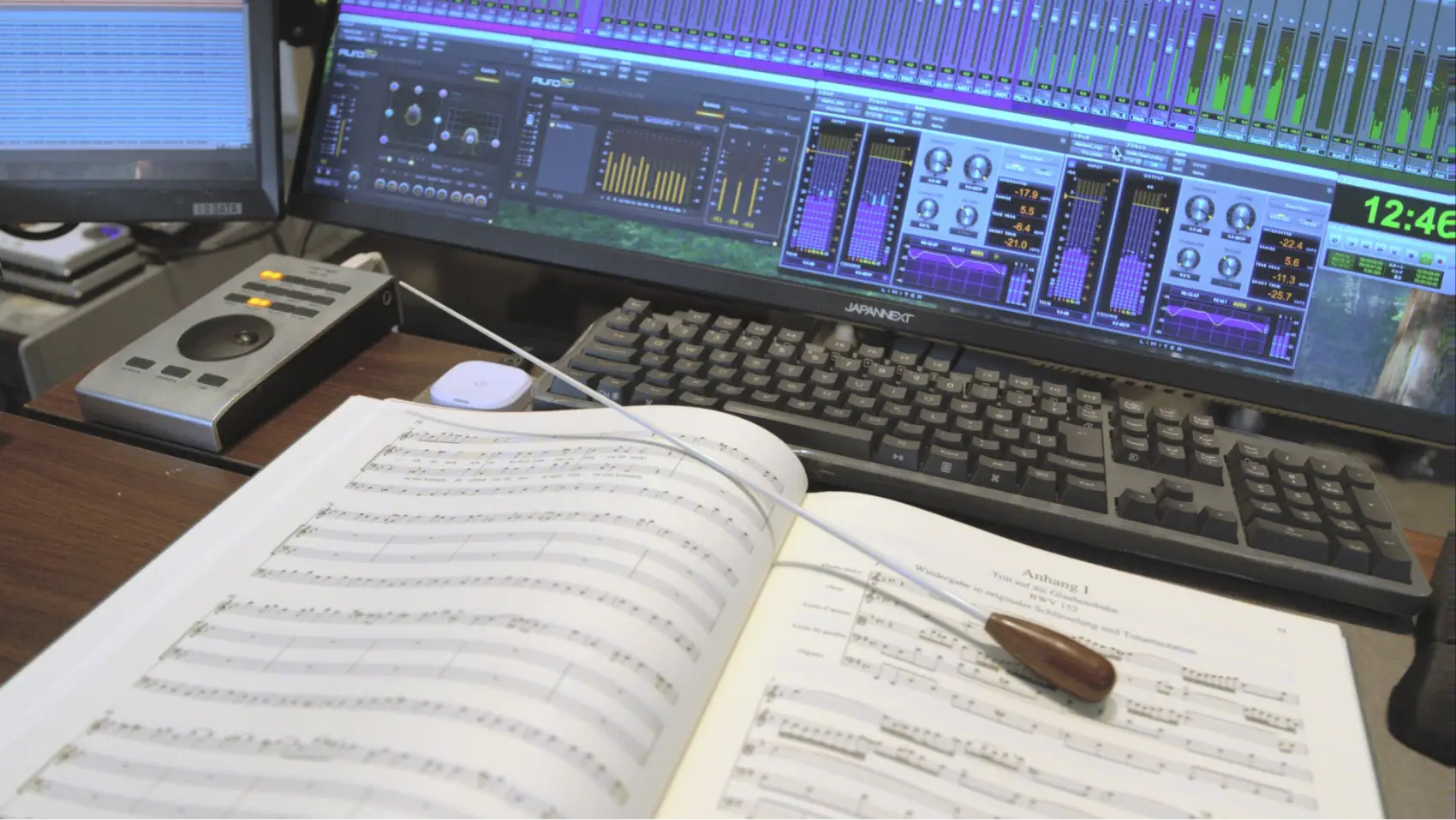
Accurately conveying the direction and distance of sound, as well as the sense of space and scale, requires a solid foundation in acoustics and extensive practical experience. At the same time, creating a sound space that truly moves the listener requires sensitivity to music and environmental sound, along with the ability to express their character and atmosphere.
By reproducing not only the performance itself, but also the subtle details such as the performer’s breathing, the resonance of the concert hall, and the ambience of the surrounding space, Immersive Audio creates a sense of realism and presence that conventional recordings cannot fully convey. It is more than simply a means of recording sound. It can be regarded as a new form of sonic expression—one that captures and conveys the acoustic space itself.
3The Three Essential Elements of Immersive Audio

- Envelopment
- : A sense of being enveloped by sound.
- Spaciousness
- : A sense of sound extending in depth (front to back), width (left to right), and height (above and below).
- Surrounding Presence
- : A sensation that the sources of sound are surrounding the listener.
Outstanding Immersive Audio productions achieve a well-balanced expression of all three elements: Envelopment, Spaciousness, and Surrounding Presence. When these three elements work together in harmony, sound is not simply perceived as coming from specific directions. Instead, it spreads naturally throughout the surrounding space, allowing listeners to experience a rich sense of realism and presence from a range of listening positions. This leads to the sensation of being there, as if actually present in the space.
By contrast, when Surrounding Presence is emphasized on its own, the sound may appear natural near the center of the speaker arrangement—the sweet spot—but the balance can deteriorate as the listener moves away from it. The sense of spaciousness and the relationships between sound sources may then begin to sound unnatural. The essence of Immersive Audio is not simply to surround the listener with sound. It is to create a natural, three-dimensional sound space in which Envelopment, Spaciousness, and Surrounding Presence are brought into harmony.
4The Importance of Sound Quality in Immersive Audio
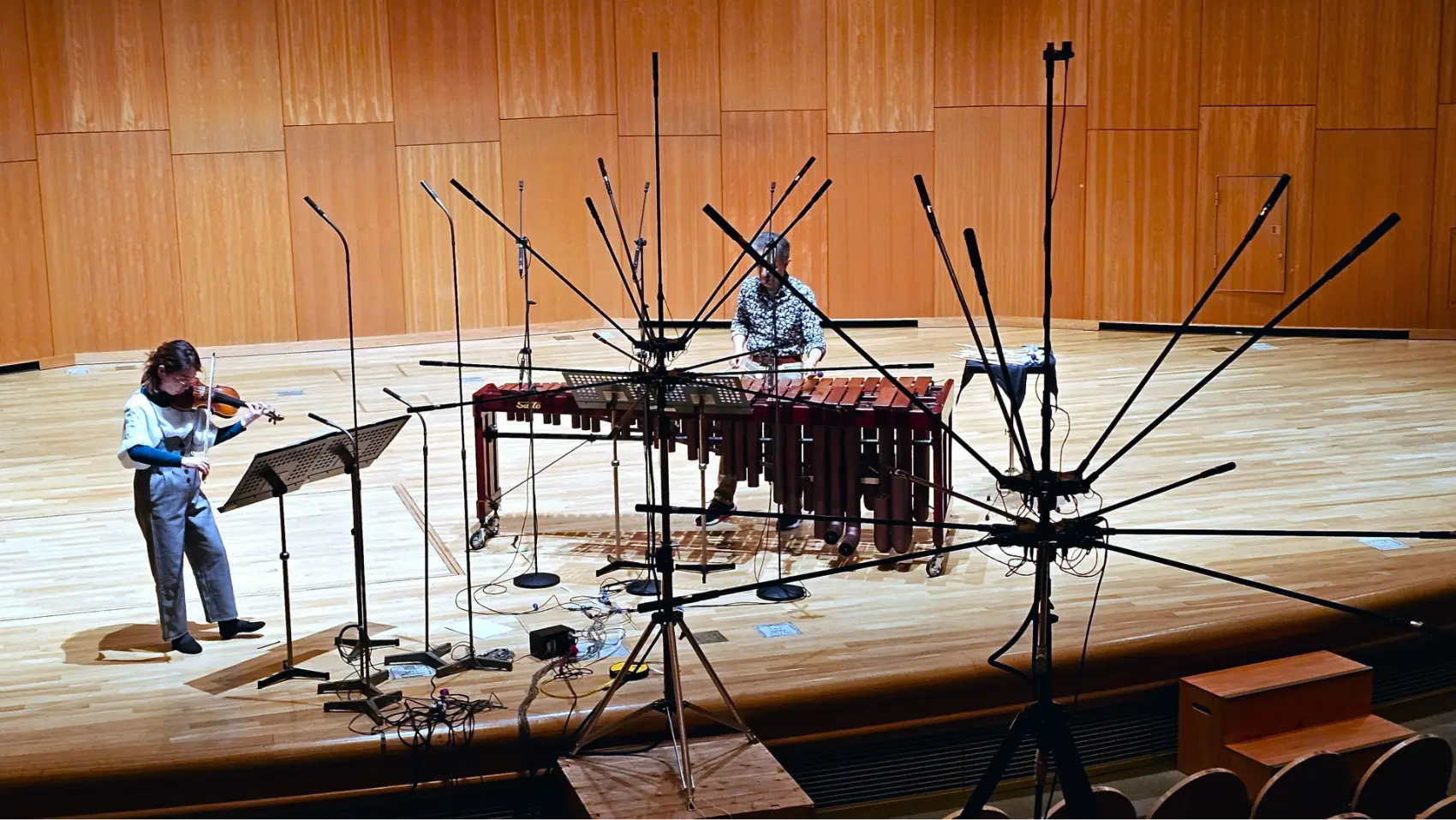
Immersive Audio recording captures the performance, along with the resonance of the concert hall and the surrounding spatial information.
Sound Quality Shapes the Immersive Experience
Immersive Audio reproduces sound in three dimensions, creating the sensation of being there, as if actually present within the space. However, spatial reproduction alone is not enough. One of the most important factors is the quality of the sound itself. No matter how accurately a three-dimensional sound field is reproduced, poor sound quality cannot fully convey the expression of the performance, its subtle textures, or the natural ambience of the space. To create a truly convincing sense of presence, it is essential to achieve a balance between accurate spatial information and high-quality sound.
Fewer Opportunities to Experience High-Quality Sound
Today, many people enjoy music through smartphones and streaming services. While these services offer remarkable convenience, audio data is often compressed to reduce the amount of data transmitted. The compressed audio we hear every day may convey objective information, such as the words being spoken or the basic content of the music, but much of the rich emotional information and natural texture contained in the original sound can be diminished.
As with art and cuisine, there are things whose differences can only truly be appreciated through direct experience with the real thing. The same is true of sound; experiencing high-quality sound helps cultivate our sensitivity to its subtle qualities. For many people, their first experience of Immersive Audio is a striking one. They are often surprised by the difference from the sound they have been accustomed to hearing and moved by the sensation of being enveloped by sound and the realism that makes them feel as if they are actually there. When they compare high-quality Immersive Audio with a compressed version delivered through a streaming service, most listeners quickly notice that subtle details are lost through compression.
To learn more about audio compression, see Audio Compression.
Toward an Era of Authentic Sound
In 2025, two high-quality immersive audio streaming services, Pure Audio Streaming and Auro Masters, were launched. A new era has begun in which high-quality Immersive Audio, once available only in specialized listening environments, can now be experienced through streaming services. Immersive Audio, combining accurate spatial reproduction with high-quality sound, has the potential to take the experience of music, films, and the sounds of nature to a new dimension.
5Why Immersive Audio, Now?

From Research to Practical Technology
The concept of Immersive Audio is by no means new. Research into reproducing sound within a three-dimensional space has been conducted in the field of acoustics since the latter half of the twentieth century. At the time, however, realizing such systems required large numbers of loudspeakers and sophisticated signal processing. As a result, the technology was limited to specialized research institutions and dedicated facilities.
A Turning Point Driven by Technological Innovation
In recent years, advances in digital signal processing, together with the declining cost of audio equipment, have made three-dimensional sound reproduction using multiple loudspeakers increasingly practical. The widespread adoption of Dolby Atmos, which was originally developed for the motion picture industry, has also expanded access to immersive audio in home entertainment environments. At the same time, advances in streaming technology have made it possible to deliver music and video in 3D audio formats, bringing immersive experiences to a much wider audience.
Changing the Way We Experience Sound
Against this technological backdrop, Immersive Audio has evolved from a subject of research into a practical technology. Its applications are now extending beyond music and film into a wide range of fields, including tourism, education, welfare, and wellness. Immersive Audio is more than simply a new audio technology. It has the potential to transform the way people experience and engage with sound, creating new forms of value and opening the door to entirely new experiences.
6Immersive Audio Opens New Dimensions in Sound

Connecting People and Spaces Through Sound
The potential of Immersive Audio extends beyond entertainment, with applications also being explored in healthcare and welfare. For people who have difficulty leaving home due to illness, age, or other physical limitations, Immersive Audio can provide new opportunities to enjoy music, theatre, and live performances in their everyday surroundings. It may also contribute to improving acoustic environments in hospitals, senior care facilities, and residential spaces. As a technology that can help create more comfortable acoustic environments while supporting emotional well-being, Immersive Audio has the potential to play an increasingly important role in the years ahead.
Preserving Our Sonic Heritage for the Future
Immersive Audio also holds great promise for the preservation and transmission of cultural heritage. In March 2024, I recorded Shingon Shōmyō—the ritual Buddhist chanting performed by Reverend Yoshimasa Kojima—using Immersive Audio. Shingon Shōmyō is a form of Buddhist liturgical music in which sutras and sacred verses are chanted with melodic intonation. In July 2025, Reverend Kojima’s Shingon Shōmyō was selected by the Agency for Cultural Affairs of Japan as an Intangible Cultural Property for which measures such as documentation should be taken (Performing Arts Division). Immersive Audio can preserve not only the voice itself, but also the performer’s breathing, the resonance of the surrounding space, and the atmosphere of the occasion. As a means of preserving and conveying sonic heritage to future generations, its value is likely to grow even further.
7Applications of Immersive Audio

So far, I have explored how Immersive Audio works and the possibilities it offers. Its potential extends far beyond music and visual entertainment. Applications are being explored across a wide range of fields, including wellness, tourism, cultural heritage preservation, and community services. How, then, can Immersive Audio be used in real-world settings? The Applications of Immersive Audio page introduces practical examples of how Immersive Audio can be applied and explores the possibilities for its implementation in a variety of fields.

