

Some readers may not know the word “monophonic” — so thoroughly have “monaural” and “stereo” taken hold. What these words mean, however, matters. Let us unpack them.
1. Where the Words Come From — the Ear and the Reproduced Sound
“Monaural” is mon- (one) + aural (ear), meaning “one ear,” and was originally a word that assumed listening on headphones. Yet we have come to use it for single-channel reproduction.
If what we want to denote is the reproduction of a single sound source, the correct word is mono + phonic (sound) = “monophonic.” That word assumes reproduction over loudspeakers.
The opposite of monaural is bin- (two) + aural = “binaural,” not stereo. Stereo is short for stereophonic, which is the counterpart of monophonic.
The stereo in stereophonic derives from the Greek stereos, meaning “solid” or “three-dimensional.” Since the word stereo says nothing in itself about the number of channels, reproduction over two loudspeakers is sometimes distinguished as “two-channel stereophonic.” There was once also a way of calling this two-channel stereophony bi + phonic = “biphonic” (two sounds).
Monaural, in this way, is a word focused on the ear, while monophonic is a word focused on the reproduced sound. The everyday contrast of “mono versus stereo,” then, was a comparison that mistook the meanings the words started from.
2. Comparing the Terms
In headphone reproduction the signals are delivered to the left and right ears independently, so the left channel reaches only the left ear. In loudspeaker reproduction, by contrast, the sound from the left loudspeaker reaches not only the left ear but the right ear as well. The way sound reaches the ears is thus fundamentally different between headphones and loudspeakers.
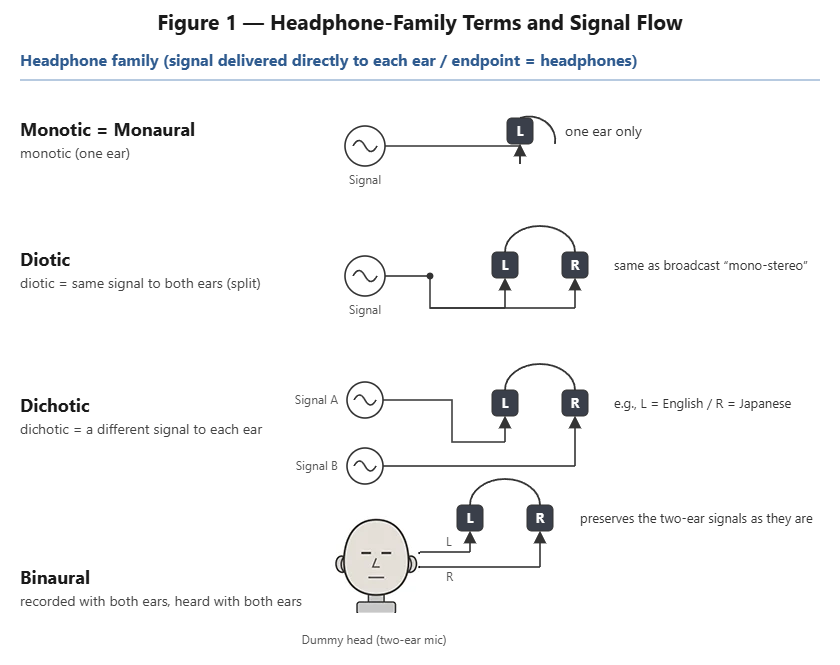
In psychoacoustic experiments using headphones, presentation to one ear is called “monotic,” the same signal to both ears “diotic,” and different signals to each ear — English to the right ear and Japanese to the left, for example — “dichotic.” The ending -otic derives from the Greek ous (ear) and has the same sense as the aural (Latin auris) of monaural. The same “ear,” in other words, is named with Latin roots in the world of reproduction (monaural, binaural) and with Greek roots in the world of hearing research (monotic, diotic, dichotic).
Monotic and monaural are completely synonymous. Dichotic, on the other hand, delivers different signals to the two ears and might therefore be thought to include binaural. In psychoacoustic experiments, however, the very aim is to probe hearing by giving the two ears different stimuli, which is a different purpose from binaural, where the goal is to recreate a space. The two are therefore not synonymous (Figure 1).
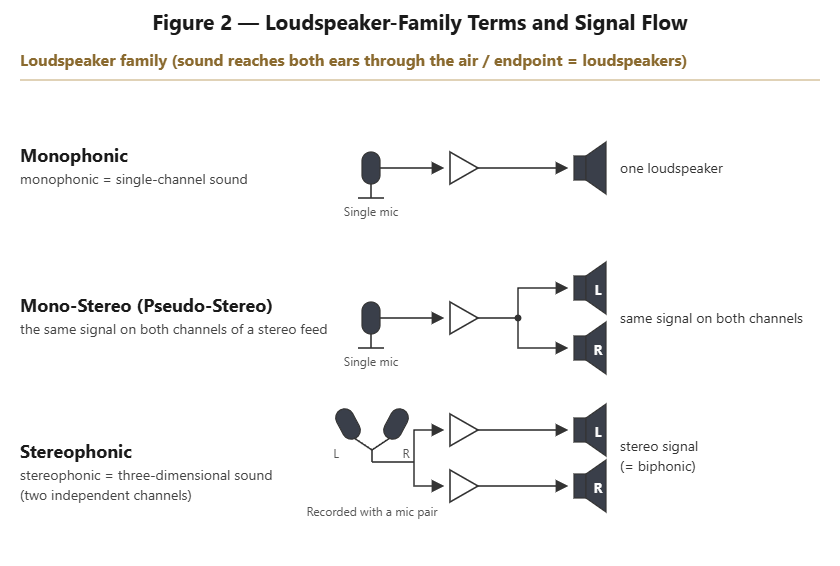
Loudspeakers, meanwhile, deliver sound to both ears through the space of the room and form sound images outside the head. This is the domain that monophonic and stereophonic describe. Japanese broadcasting even had a term of its own, monosute (pseudo-stereo): feeding the same signal to the left and right of a stereo transmission. Structurally, it is the very image of diotic presentation (Figure 2).
Words evolve, and “mono vs. stereo” has become firmly established as a familiar pairing. Even so, tracing the origins of these terms offers a glimpse into the history of audio.

