

Immersive Audio is an audio technology that reproduces sound three-dimensionally, creating a spatial experience that gives listeners the sensation of actually being there.
Listeners often describe the experience with words such as “being enveloped by sound,” “a sense of depth,” “powerful realism,” and “deeply moving.” In a listener survey conducted during demonstration sessions in 2017, participants described 3D Audio—another term for Immersive Audio—with expressions such as “realism,” “envelopment,” and “spaciousness.”
Terms Used to Describe 3D Audio (Immersive Audio)
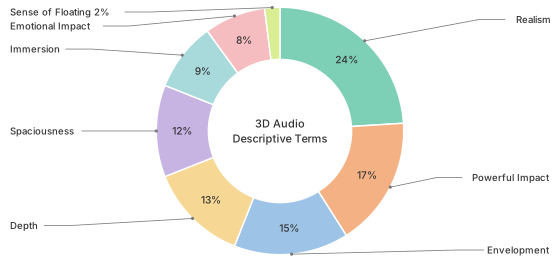
These qualities differ from the criteria traditionally used to evaluate sound quality. Rather than describing the fidelity or quality of sound itself, they express how people perceive and experience acoustic space and the surrounding environment. The value of Immersive Audio lies not only in achieving higher sound quality, but also in creating new and meaningful experiences through sound.
Fields Expected to Benefit from 3D Audio (Immersive Audio) Applications
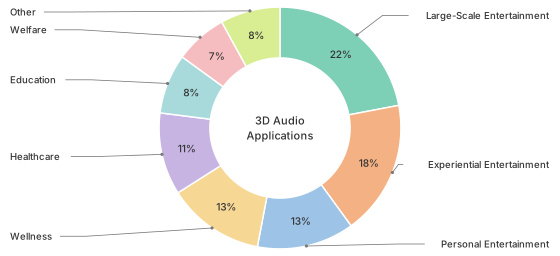
A questionnaire survey conducted in 2017 also explored the fields in which 3D Audio (another term for Immersive Audio) was expected to have potential applications. The results showed that, in addition to music and visual entertainment, respondents saw potential in a wide range of fields, including wellness, tourism, education, welfare, and residential environments.
In other words, listeners intuitively recognized the potential of Immersive Audio to enrich people’s lives and the environments in which they live.
The following are some representative examples of how Immersive Audio can be applied.
1Applications in Entertainment
Reproducing Spatial Information for Immersive Experiences
One of the most important applications of Immersive Audio is in the field of entertainment. Its use extends across a wide range of content, including live music performances, classical concerts, jazz, popular music, theatre, films, sporting events, live-viewing experiences, and streamed events.
The appeal of these experiences lies not only in the performance or event itself. The acoustics of the venue, the presence of the audience, the resonance of applause, the perceived distance between performers and listeners, and the overall atmosphere of the space all play an important role in shaping the emotional experience.
By reproducing this spatial information, Immersive Audio creates a deeper sense of immersion. Even for people who are unable to attend an event in person, it can deliver a sense of realism and presence that conventional streaming cannot fully convey, bringing them closer to the experience itself.
Enhancing Content Value
The enhanced experience provided by Immersive Audio can also increase the value of the content itself. In 2022, a questionnaire survey was conducted during listening sessions to examine how much additional cost listeners would be willing to pay for Immersive Audio streaming. The results are shown in the charts below.
Additional Amount Willing to Pay for Immersive Audio
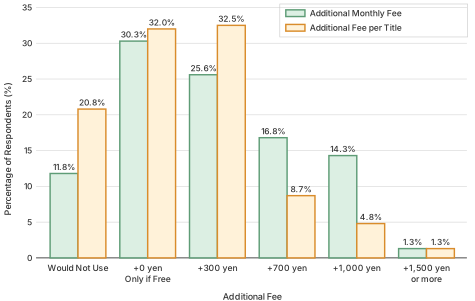
The survey revealed that many respondents were willing to pay an additional fee for both monthly subscription services and pay-per-title purchases.
For monthly subscription services, approximately 58% of respondents indicated that they would accept an additional monthly fee of 300 yen or more. About 32% were willing to pay 700 yen or more, while approximately 16% indicated that they would pay 1,000 yen or more.
For pay-per-title purchases, approximately 47% of respondents were willing to pay an additional 300 yen or more. About 15% were willing to pay 700 yen or more, while approximately 6% indicated that they would pay 1,000 yen or more.
These findings suggest that listeners recognize Immersive Audio as an experience worth paying a premium for.
As competition among music and video streaming services continues to intensify, this enhanced experience—and the additional value it brings to content—can serve as an important differentiating factor. Immersive Audio not only enhances the appeal of works and events, but also has the potential to create new revenue opportunities and strengthen brand value.
2Applications in Wellness
Designing Acoustic Environments
In recent years, numerous studies have reported that natural sounds and pleasant acoustic environments can contribute to stress reduction and psychological well-being. Research is also advancing into the beneficial effects that immersive environments created through spatial audio may have on both the mind and body.
Against this background, the importance of acoustic environments is receiving renewed attention in wellness facilities, relaxation spaces, and healthcare and welfare facilities.
Services incorporating high-resolution nature recordings and functional background music are also becoming increasingly common. While many of these services focus primarily on the pleasantness and quality of the sound itself, relatively few take into consideration the sound field—the direction from which sounds are heard and how they spread throughout a space.
Recreating Natural Sound Fields
Sounds heard in nature are inherently three-dimensional. Birds can be heard overhead or from distant trees, the sound of a flowing stream conveys depth, and the sound of the wind moves naturally through the surrounding space.
Hi-Res Immersive Audio can reproduce not only the fine details of sound, but also spatial information such as the direction, distance, and height from which sounds are perceived.
This makes it possible to create not simply an environment in which nature sounds are played as background music, but an acoustic environment that itself gives the sensation of being immersed in nature. The feeling of being enveloped by sound and the sense of spaciousness can lead to a more natural and enriching listening experience.
Listeners who have experienced these sounds have commented that they felt “relaxed” and “refreshed both mentally and physically.” I have also received inquiries from healthcare professionals about the potential use of this technology as background music in hospitals, suggesting that there is growing interest in improving acoustic environments in healthcare and welfare settings.
Looking ahead, Hi-Res Immersive Audio is expected to find wider applications not only in wellness facilities, but also in healthcare and welfare facilities, offices, residential environments, etc. It has the potential to serve as a technology for designing acoustic environments in the places where people spend much of their time.
3Applications in Tourism and Community Services
Communicating the Character of a Place Through Sound
The memories we take home from a journey are shaped by far more than what we see. The ringing of temple bells, the calls of festival participants, the resonance of fireworks, the murmur of a flowing stream, the sounds of a forest, the bustle of a town, etc. all contribute to the unique character of a place.
With Immersive Audio, these distinctive local soundscapes can be captured with high-quality sound and delivered as vivid, spatial experiences to people who are unable to visit the location in person.
Potential applications include interactive exhibits at tourist information centers and Michi-no-Eki roadside stations, local soundscape content for hotels and traditional Japanese inns, promotional videos produced by local governments and tourism businesses, and immersive exhibitions for international visitors.
Sound does more than simply provide information. It has the power to inspire people to think, “I want to go there,” or “I want to experience it for myself.”
One example comes from "Fukuya", a traditional Japanese sweet cafe in Atami-city, Shizuoka-pref., Japan, where Immersive Audio was introduced. When the three-dimensional sound of the Atami Seaside Fireworks Festival was played in the shop, some visitors were so impressed by the experience that they later returned to Atami to attend the actual fireworks festival in person.
Preserving Regional Culture for Future Generations
Immersive Audio also has an important role to play in preserving and passing on regional culture.
The sounds of traditional festivals, vanishing local traditions, the chants and performances of master practitioners, and the sounds of skilled artisans at work are all valuable cultural assets unique to a region. Yet these sounds change over time and, in some cases, may eventually disappear.
By preserving the acoustic space itself, Immersive Audio can carry the atmosphere and presence of a place into the future—qualities that photographs and conventional video recordings alone cannot fully capture. Immersive audio archives of cultural properties, traditional events, and festivals offer new possibilities for preserving regional culture and passing it on to future generations.
Sharing Cultural Experiences Within Local Communities
Live streaming with Immersive Audio also has significant potential as a service for local communities.
People living in rural areas may find it difficult to attend concerts and theatrical performances in major cities. Others may have difficulty traveling because of age, illness, childcare, or caregiving responsibilities. Immersive Audio can bring highly realistic cultural experiences to these people, even when attending in person is difficult.
By presenting concerts and cultural events from major cities at community centers, welfare facilities, hotels, local tourism facilities, etc., people can enjoy high-quality cultural experiences while remaining within their own communities.
Immersive Audio enhances the value of local communities through meaningful experiences with sound, in three key areas: tourism promotion, community services, and cultural archiving.
4Designing Acoustic Environments for Every Purpose
To fully realize the potential of Immersive Audio, careful design of the sound environment, tailored to the intended purpose and the characteristics of each space, is essential.
Even when the same immersive audio technology is used, the recording techniques, production methods, and playback environments required to recreate the sense of presence at a concert can differ significantly from those required to create a space for relaxation and restoration. Immersive Audio should therefore be approached from the experience to be created, with the sound environment designed accordingly.
Drawing on experience gained through broadcasting, music production, and research into 3D Audio, Irimajiri Immersive Audio Laboratory provides comprehensive support for creating acoustic environments tailored to specific purposes. This includes Hi-Res Immersive Audio recording of music, natural sounds, and environmental sounds; content production; playback environment design and consultation; and the planning of listening sessions and demonstrations.
Scientific Knowledge Supporting Acoustic Environment Design
The relationship between acoustic environments and human physical and mental well-being has been the subject of extensive research both in Japan and internationally.
Alvarsson et al. reported that listening to natural sounds following psychological stress may promote faster recovery from stress responses than exposure to environmental noise. [1]
Greenberg et al. investigated the effects of experiences using spatial audio and immersive three-dimensional environments on stress and negative mood states. Their work is among the pioneering studies exploring the potential of 3D Audio for wellness applications. [2]
Jougasaki et al. reported that exposure to hypersonic sound—sound containing ultra-high-frequency components [4]—enhanced autonomic nervous system regulation, with particularly notable effects observed in older adults whose autonomic function had declined with age. [3]
These findings suggest that sound can serve not merely as a means of conveying information, but also as an environmental element that supports human comfort and quality of life.
At Irimajiri Immersive Audio Laboratory, the potential of acoustic environment design using natural and environmental sounds is explored, drawing on these and other scientific findings.
References
- Alvarsson, J. J., Wiens, S., & Nilsson, M. E. (2010) Stress recovery during exposure to nature sound and environmental noise International Journal of Environmental Research and Public Health, 7(3), 1036–1046.
- Greenberg, D. M., Bodner, E., Shrira, A., & Fricke, K. R. (2021) Decreasing stress through a spatial audio and immersive 3D environment Music & Science, 4.
- Jougasaki, K., Kawai, N., & Honda, M. (2025) Enhancing the regulatory function of the autonomic nervous system by exposure to hypersonic sound Scientific Reports, 15.
- Oohashi, T. et al. (2000) Inaudible high-frequency sounds affect brain activity: Hypersonic effect Journal of Neurophysiology, 83(6), 3548–3558.

